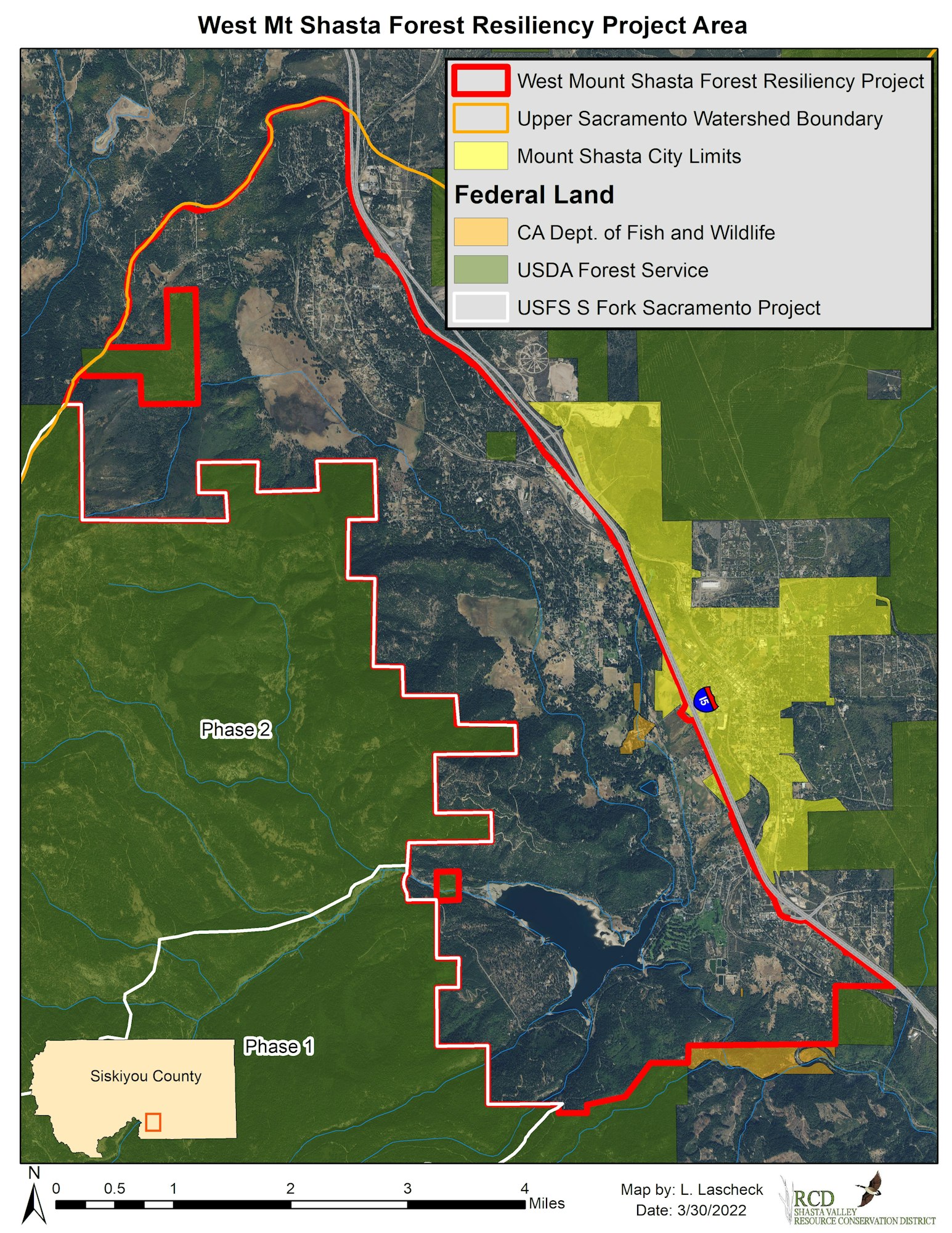
West Mount Shasta Forest Resilience Project

This project is located in the Upper Sacramento Watershed west of Interstate-5 in the Wildland Urban Interface (WUI) west of the City of Mount Shasta to the Shasta-Trinity National Forest. It consists of vegetation treatments that will reduce wildfire risks to both the community and forest lands, increase forest resiliency, and enhance wildlife habitat.
This project covers about 13,000 acres of private lands and will connect past and future cross-boundary, landscape-level treatments in the Mount Shasta area. Proposed treatments include thinning, brush reduction, prescribed burning, and meadow restoration.
The Goals and Objectives of the project include:
- Provide for public safety and community protection by reducing wildfire risks, removing hazardous fuels, providing for defensible space around structures in the WUI, and creating safe ingress and egress for communities and firefighters to utilize in the event of a wildfire
- Improve forest resilience to reduce impacts from threats such as wildfire, drought, and pests by restoring forest ecosystem to conditions consistent with historical fire regimes, enhancing meadows by removing encroaching vegetation and reintroducing fire, and increasing ecosystem diversity.
SVRCD has engaged many local stakeholders in the development of this project including the Shasta Trinity National Forest, CalFire, Natural Resource Conservation District, Mount Shasta Fire Safe Council, Siskiyou Land Trust, and the McConnell Foundation.
Phase 1 of implementation was completed in March 2025 and treated approximately 1500 acres. Phase 2 began in Fall 2025 with plans to treat over 1300 acres.
West Mt. Shasta Forest Resilience Phase I and II are part of California Climate Investments, a statewide program that puts billions of Cap-and-Trade dollars to work reducing GHG emissions, strengthening the economy, and improving public health and the environment- particularly in disadvantaged communities. The Cap-and-Trade program also creates a financial incentive for industries to invest in clean technologies and develop innovative ways to reduce pollution. California Climate Investments projects include affordable housing, renewable energy, public transportation, zero-emission vehicles, environmental restoration, more sustainable agriculture, recycling, and much more. At least 35 percent of these investments are located within and benefiting residents of disadvantaged communities, low-income communities, and low-income households across California. For more information, visit the California Climate Investments website at: www.caclimateinvestments.ca.gov.